
Large garden design ideas for Scottish homes
Updated: 4 days ago
A large garden is a rare thing. Most homeowners in Scotland work with modest plots, so when you have space to play with, you want to use it well.
The challenge with big gardens is not lack of ideas. It is knowing which ideas work together. Without structure, large spaces feel empty, disjointed, or hard to maintain.
This guide covers how to approach a large garden redesign in Scotland. You will find practical advice on layout, materials, planting, and features that suit our climate. Whether you are planning a full transformation or refining what you have, these ideas will help you create a garden that feels complete.
What to consider before redesigning a large garden

Before you sketch layouts or choose materials, spend time understanding your site. Large gardens often have varied conditions across the plot.
Walk the space at different times of day. Note where the sun falls in morning and evening. Check which areas stay damp after rain. Identify exposed spots where wind funnels through.
Think about how you actually want to use the garden. Do you need space for children to play? Somewhere quiet to sit? Room for entertaining groups? A large plot can accommodate all of these, but only if you plan for them.
Consider maintenance from the start. A garden that looks impressive in photographs but takes every weekend to manage is not a success. Be honest about how much time you will spend on upkeep. Working with a professional garden design team helps you balance ambition with practicality.
Create a strong layout with zones

The single most important decision in a large garden is how you divide the space. Zoning gives purpose to different areas and creates a sense of journey as you move through the garden.
Without zones, a big garden becomes one flat expanse. With them, you create distinct outdoor rooms, each with its own character and function.
Social zone

This is your main entertaining space. Position it close to the house for easy access to the kitchen. A large patio or deck works well here, with room for dining furniture and seating. In Scotland, consider overhead cover or a pergola to extend use through changeable weather. For ways to zone a big plot for eating and entertaining, see our outdoor living space ideas for Scottish gardens.
Family zone

If you have children, dedicate an area to play. Keep it visible from the house and social zone. Lawn works well for younger children. Older kids might want a sports area or space for a trampoline. This zone can evolve as the family grows.
Quiet or wellness zone
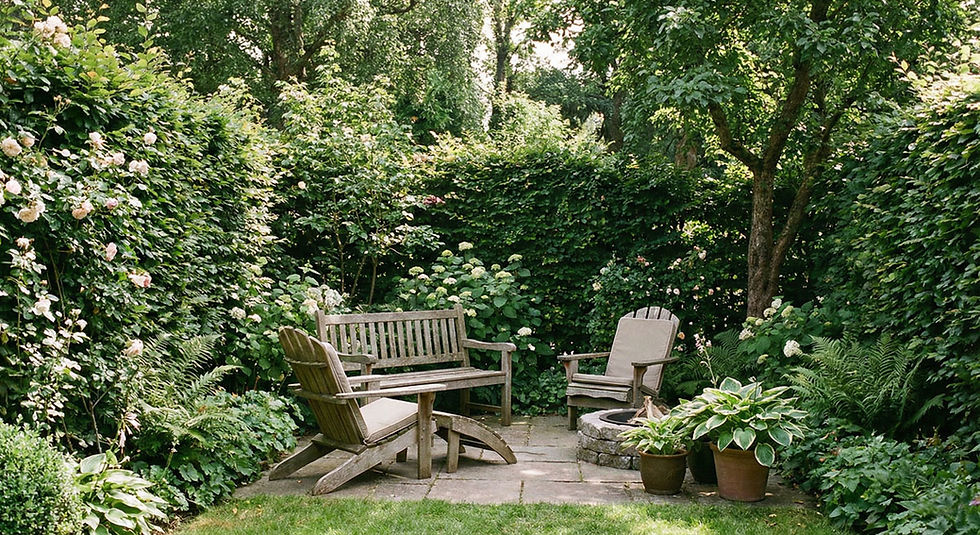
Large gardens can accommodate a retreat. Position this away from the main activity areas. A bench surrounded by planting, a small water feature, or a secluded seating area all work. This becomes the part of the garden where you go to think or read.
Utility zone

Every garden needs storage, bins, compost, and possibly a greenhouse or shed. Screen this area from view but keep it accessible. Hedging, trellis with climbers, or a simple fence works well.
A professional landscaping team can help you map these zones to your specific plot and ensure transitions between them feel natural.
Use levels and terracing to shape the space

Many large gardens in Scotland sit on sloping ground. Rather than fighting the gradient, use it to your advantage.
Terracing transforms an awkward slope into a series of usable flat areas. Each terrace becomes its own zone, connected by steps that add visual interest and encourage movement through the garden.
Even on flatter sites, introducing level changes adds depth. A sunken seating area feels intimate. A raised deck provides views across the garden. Steps draw the eye and create focal points.
Retaining walls need proper construction to last. Stone or block walls with adequate drainage behind them will stand for decades. Timber sleepers offer a softer look but have a shorter lifespan in Scottish conditions. If your site has significant gradient, professional walling and steps installation prevents the structural problems that plague DIY attempts.
Choose premium materials suited to Scottish weather

Material selection matters more in Scotland than in drier climates. Rain, frost, and temperature swings test everything you install.
For paving, porcelain and natural stone perform well. Porcelain is frost proof, stain resistant, and keeps its colour. Natural stone, particularly sandstone and granite, suits traditional properties and weathers attractively over time. Our paving and patios projects use materials specified for Scottish conditions.
Composite decking has become the default for outdoor flooring in wet climates. It does not rot, warp, or splinter like timber. Hardwood decking looks beautiful but requires annual maintenance to prevent greying and algae.
For walling, natural stone matches most Scottish properties. Reconstituted stone offers consistency at a lower price point. Avoid materials that absorb water and crack when frozen.
Large planting schemes that work in Scottish conditions

Planting at scale requires a different approach than filling a small border. You need structure first, then layers of interest.
Start with trees. In a large garden, you have room for specimens that smaller plots cannot accommodate. Native trees like birch and rowan establish quickly and support wildlife. Beech and oak provide long term structure. Scots pine adds year round presence.
Build an evergreen framework next. Yew hedges, holly, and laurel provide structure through winter when deciduous plants are bare. Without this backbone, large gardens look empty from November to March.
Fill between the framework with shrubs and perennials. Group plants in drifts of the same species rather than scattering individuals. Repetition creates cohesion in large spaces.
Use grasses to add movement and late season interest. Miscanthus, Stipa, and Calamagrostis handle Scottish conditions and look good into winter.
For screening and privacy, consider a mixed native hedge rather than a single species. Hawthorn, blackthorn, field maple, and hazel together create a denser barrier and better wildlife habitat than uniform laurel.
Our planting design for large gardens includes species selection for your specific soil and aspect, ensuring plants establish quickly and thrive long term.
Create a main focal point

Every large garden needs something to draw the eye. Without a focal point, the space lacks direction.
A fire pit creates a natural gathering spot and extends evening use of the garden. Built in designs with stone or steel surrounds look more considered than portable options. See our outdoor living spaces page for examples of integrated designs.
A specimen tree can anchor a garden for generations. Japanese maples, magnolias, or multi stemmed birch provide seasonal interest and scale.
For contemporary gardens, sculpture or large planters make strong statements. Position them where sightlines naturally lead.
An outdoor fireplace or pizza oven combines function with visual impact. These features work well as the centrepiece of a social zone.
Add water features for scale and calm

Water suits large gardens better than small ones. You have room for features that would overwhelm a modest plot.
A natural pond attracts wildlife and creates a habitat. Planted edges with marginal plants soften the boundary between water and garden. Allow at least 4 square metres of surface area for a pond that sustains itself.
Rills, narrow channels of moving water, connect different garden areas. They work particularly well running alongside paths or defining the edge of a terrace.
Contemporary designs might use a reflective pool with clean edges. Still water mirrors the sky and surrounding planting, doubling the visual impact.
Sound matters with water features. A gentle cascade or bubbling spring adds auditory interest without the noise of a large fountain. In a quiet zone, even a small water feature creates atmosphere.
Use patios and decking to anchor social spaces

Hard surfaces define how you use a garden. Get the size wrong and even a beautiful patio feels cramped or lost.
For a dining area that seats six comfortably, allow at least 4 by 4 metres. Add another 2 metres depth if you want lounging furniture alongside. Large gardens can accommodate patios of 30 square metres or more without looking oversized.
Scale your materials to the space. Large format porcelain slabs at 900x600mm or bigger suit expansive patios better than small pavers. Fewer joints create a cleaner look and reduce maintenance.
Define the edges. A contrasting border in a different material or colour frames the patio and stops it bleeding into the garden. Granite setts or dark slate against pale porcelain work well.
Consider built in seating walls around the perimeter. These reduce furniture clutter, provide permanent structure, and double as planting bed edges. A 450mm height works for comfortable seating.
For evening use, integrate heating into the design. Infrared heaters mounted on pergola posts or walls provide instant warmth without the smoke of a fire pit. Fire tables offer a focal point with heat. These options let you use the space from March through October rather than just high summer.
Lighting design for large gardens

Good lighting transforms how you experience a garden after dark. In Scotland, where winter evenings start early, this extends your use of the space by months.
Path lighting guides movement and improves safety. Low level bollards or recessed ground lights mark routes without creating glare. Space them close enough that you can see where to step.
Uplighting on trees creates drama. Position lights at the base of specimen trees, angled up into the canopy. The shadows and highlights change with the seasons as foliage comes and goes.
In social zones, use warm white lighting at low levels. Avoid bright floodlights that flatten the atmosphere. Festoon lights, wall mounted downlights, or lanterns on tables create intimacy.
For water features, underwater lighting adds a new dimension. LEDs rated for submersion highlight movement and reflections.
Manage exposure, drainage, and Scottish climate challenges

Scotland receives 1,500mm of rainfall annually in many areas. Your garden design must account for where water goes.
Build drainage into hard surfaces from the start. Patios need a fall of at least 1 in 80 to shed water. Consider permeable paving or gravel areas that allow water to soak through rather than running off.
Lawn areas on heavy clay soil may need a land drain system. French drains filled with gravel channel water away from areas where you want to sit or walk.
Wind exposure affects plant choice and comfort. In open sites, plant shelter belts on the prevailing wind side before tackling the rest of the garden. Native hedging and trees filter wind more effectively than solid fences, which create turbulence.
Position seating areas in sheltered spots. The south facing corner against a wall receives maximum sun and minimum wind. A pergola or screen can create shelter in otherwise exposed locations.
How MacColl & Stokes design large gardens in Central Scotland
We have designed and built large gardens across Glasgow, Bearsden, Newton Mearns, Stirling, and Edinburgh for over 38 years. Our approach combines design thinking with practical construction knowledge.
Every project starts with a site visit. We assess gradients, drainage, soil conditions, and aspect before discussing ideas. This groundwork prevents problems later.
We produce scaled plans that show exactly how your garden will look and function. You see the layout, proportions, and relationships between zones before any work begins. Changes are easy on paper, expensive on site.
Our construction team builds what we design. There is no handover to a separate contractor. The people who understand the design are the people who execute it. This continuity shows in the finished result.
We use quality materials from suppliers we trust. Our stonework, paving, and planting are specified to perform in Scottish conditions. We do not cut corners on foundations, drainage, or preparation.
View our full range of landscaping services to see how we can help with your project.
Speak to our team
If you have a large garden and want to make better use of the space, we would be glad to discuss your ideas.
Request a free consultation and we will visit your property to understand the site and your goals. From there, we can advise on approach, timescales, and investment.
Contact MacColl & Stokes to arrange your consultation. Call 01360 550 309 or complete our online enquiry form.


