How to Level a Sloped Garden
Updated: Jul 20

A sloping garden wastes valuable outdoor space. Water pools on lawns. Patios sink or crack. Children cannot play safely. Entertaining becomes awkward when guests perch on uneven ground. For larger properties, the problem multiplies: acres of unusable terrain that should be an asset.
The solution is levelling or terracing, but the process demands expertise. Scottish weather, drainage requirements and structural considerations make this more than a weekend project. Poor execution leads to erosion, waterlogging and retaining walls that fail within years.
This guide explains what professional garden levelling involves: how we assess slopes, when to flatten versus terrace, the construction process, materials that last, and what separates a quality result from a budget compromise.
Assess Your Garden Slope and Site Conditions
Before any work begins, we need accurate measurements. The gradient determines the approach.

To measure gradient, place a long straight edge horizontally from the top of the slope. Measure the vertical drop at the lower end. A 1:10 gradient means a 1 metre drop over 10 metres of horizontal distance. Anything steeper than 1:3 typically requires terracing rather than full levelling.
Soil type matters. Central Scotland has varied ground conditions. Clay soils hold water and shift with seasonal changes. Sandy soils drain freely but erode without stabilisation. Rocky ground needs machinery to break through. Each soil type affects drainage design and compaction methods.
Aspect plays a role too. South-facing slopes dry faster. North-facing slopes retain moisture longer and need more extensive drainage. Note where water currently flows during heavy rain. This reveals where problems will concentrate once earthworks begin.
For larger properties, a topographical survey provides precise contour data. This allows accurate calculation of cut and fill volumes, retaining wall heights, and drainage requirements before any ground is broken.
Should You Flatten or Terrace?

The steeper your slope, the more soil movement required. Beyond a certain gradient, terracing becomes the only practical and aesthetically pleasing option.
Full levelling suits gentle slopes up to about 1:10 gradient. Soil is cut from the high side and redistributed to the low side. The result is a single flat plane, ideal for expansive lawns, large patios or outdoor entertaining spaces.
Terracing creates multiple level platforms separated by retaining walls. This approach suits steeper gradients and larger gardens where distinct zones add interest. A terraced garden might feature a dining terrace near the house, a lawn level for children, and a lower terrace for planting or a kitchen garden. Each space has purpose and definition.
For properties with significant slopes, retaining walls and steps become architectural features in their own right. Natural stone walls blend with the Scottish landscape and age beautifully over decades. Properly engineered walls transform a problem slope into a structured garden with real presence.
The Professional Levelling Process
Site Preparation and Setting Out
Accurate setting out prevents costly mistakes. String lines are established at finished levels and marker pegs placed at regular intervals showing cut and fill depths across the site.
Retaining wall positions are marked with allowance for foundations. A substantial stone wall needs a 600mm wide concrete foundation, so the finished lawn edge sits further back than homeowners often expect. These details should be clarified before work begins.
Clearing and Stripping
All turf is stripped from the working area. On larger sites, a turf cutter handles this efficiently. Turves stacked grass-side down decompose into useful topsoil over 6-12 months for use elsewhere on the property.
Trees, shrubs, old structures and hard surfaces are removed. Roots are excavated completely. Buried organic matter decomposes and creates sinkholes, so thorough clearance now prevents problems later.
Earthworks and Retaining Structures
This is the transformative phase. Mini excavators and dumpers move soil efficiently on larger sites. Hand work suits confined areas or where access restricts machinery.
The cut zone (high side) is excavated first, with topsoil stockpiled separately from subsoil. Subsoil moves to the fill zone (low side) in layers of 150-200mm, each layer compacted before the next. Proper compaction prevents settlement. Without it, lawns develop waves and paving sinks within months.
Retaining walls are constructed before final soil levels. Foundations sit on solid ground below the frost line (minimum 450mm in Scotland). Our walling and steps work ranges from dry stone construction to formal ashlar, depending on the property style and client preference.
Drainage Installation
Scottish rainfall demands serious drainage. Land drains (perforated pipes in geotextile sleeves) intercept groundwater. Gravel backfill behind retaining walls prevents hydrostatic pressure building up. Surface water channels capture runoff from paved areas.
All drainage connects to a main outfall: either an existing system, a new soakaway (where ground conditions allow), or a dedicated drain to a watercourse. Drainage should be designed for the heaviest rainfall, not average conditions.
Topsoil and Fine Grading
With subsoil level and compacted, topsoil is spread to appropriate depths: 150mm minimum for lawns, 300mm or more for planting beds. Imported topsoil is screened and certified where needed.
The surface is raked to remove stones and debris, then consolidated without over-compacting. Levels are checked with laser equipment and long straight edges. The finished surface appears flat but incorporates subtle falls (1:80 to 1:100) directing water to drainage points.
Quality Verification
The entire area is walked checking for soft spots where compaction may have failed. After rain, water flow is verified to ensure it moves as designed, away from buildings and towards collection points.
This final verification catches any issues before hard landscaping or turfing begins.
Addressing a low spot now takes minutes. Discovering it after paving is laid costs thousands.
Materials That Define Quality
The materials specified determine whether your levelled garden performs for five years or fifty.
Retaining Walls
Natural stone suits Scottish properties. Local sandstone or granite weathers attractively and improves with age. A well-built stone wall becomes a feature, not just a functional element. For contemporary properties, rendered blockwork or gabion baskets offer cleaner lines.
Timber sleepers appear in budget landscaping but have no place in quality work. Even treated timber rots within 10-15 years. The cost of replacement, including disruption to established planting, far exceeds the initial saving.
Drainage Components
Heavy-duty land drain pipe is essential, not the lightweight versions sold at DIY stores. Geotextile wrapping prevents soil migration into pipes. Gravel is washed and graded, not recycled rubble that blocks systems within years.
Surface Finishes
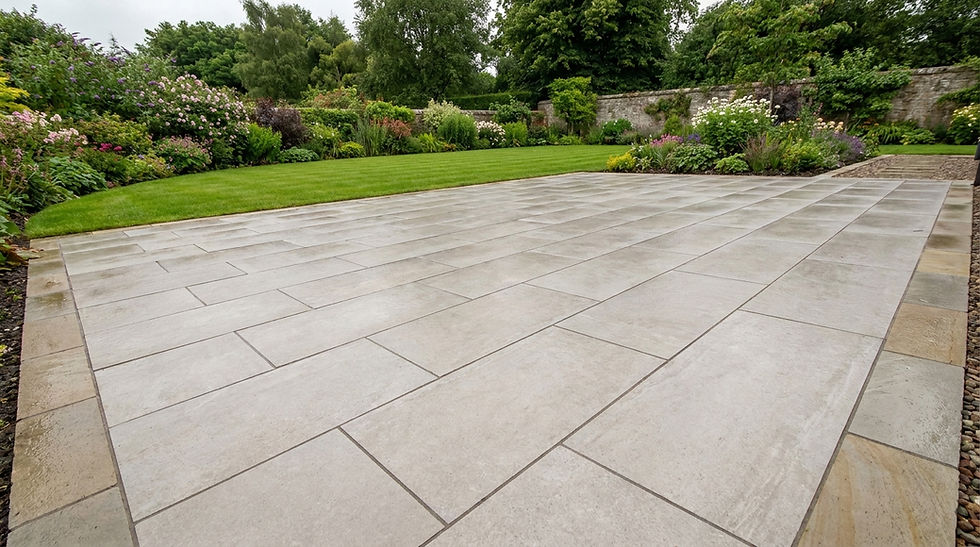
Your levelled garden needs a surface. Options include turfed lawn, natural stone or porcelain paving, timber or composite decking, or artificial grass for low-maintenance areas.
Each surface has specific base requirements. Paving needs a compacted sub-base and mortar or priming slurry bed. Decking requires a framework allowing air circulation. Artificial grass sits on a crushed stone base with precise drainage falls. These bases should be built to manufacturer specifications, which is why professional installations carry full guarantees.
Scottish Weather and Drainage Realities
Central Scotland receives 1,200-1,500mm of rain annually. West-facing slopes catch even more. Your levelled garden must handle this volume without flooding, eroding or turning to mud.
Surface water management starts with falls. Every paved and grassed area slopes towards collection points at 1:80 minimum (12mm per metre). Channel drains along paving edges capture sheet flow. Permeable paving reduces runoff where appropriate.
Groundwater requires subsurface drainage. On clay soils, this means a full land drainage system with pipes at 3-5 metre spacing, all flowing to a main collector drain. The cost is significant but the alternative is a garden that waterloogs every winter.
Frost affects structural elements. Retaining wall foundations must sit below frost depth or they heave with freeze-thaw cycles. Paving joints need flexible pointing compounds that move without cracking. These details distinguish professional installation from work that fails within a few Scottish winters.
Completing the Picture: From Levelled Ground to Living Garden

A levelled site is raw potential. The value comes from what you create on that platform.
Consider how you want to use the space. A stone patio adjacent to the house for dining and entertaining. Lawn for children or grandchildren. Planted borders that provide year-round structure and seasonal colour. Perhaps a fire pit terrace for evening gatherings.
Terraced gardens offer distinct rooms. The upper level, closest to the house, might hold the main entertaining space with views across the property. A middle terrace becomes lawn. The lower level houses a kitchen garden, cutting beds, or a wilder planted area that transitions to the landscape beyond.
Lighting extends use into evenings and transforms the garden after dark. Steps between levels need illumination for safety. Uplighting on walls and specimen trees creates drama. We design lighting schemes as part of the overall project, with cabling installed during construction rather than retrofitted later.
Material selection ties the garden to the house. A Victorian villa in Bearsden suits warm sandstone. A contemporary property in Newton Mearns takes grey granite or large-format porcelain. We source materials that complement architecture and age gracefully in the Scottish climate.
Why Professional Installation Matters
Levelling a sloped garden involves structural engineering, drainage design, heavy machinery and technical construction skills. The risks of inadequate work are serious: retaining walls that lean or collapse, drainage that fails and floods, surfaces that sink and crack.
Projects of this nature typically require:
Structural calculations for retaining walls over 1 metre
Building warrant applications in some circumstances
Coordination of multiple trades: groundworkers, masons, drainage specialists, landscapers
Plant and machinery: excavators, dumpers, compactors, lifting equipment
Quality materials sourced from specialist suppliers
Project management to keep work on schedule and within budget
The apparent savings from cutting corners disappear when walls need rebuilding, drainage needs replacing, or paving needs lifting and relaying. We see this regularly when asked to remediate failed DIY or budget contractor work.
For properties where the garden matters, where outdoor space should match the quality of the house, professional installation is the only sensible approach.
How MacColl & Stokes Approach Sloped Garden Projects
As experienced landscapers Glasgow homeowners trust, we have transformed sloped gardens across Central Scotland for over 38 years. Our approach combines technical capability with design sensibility to create gardens that function flawlessly and look exceptional. View our full landscaping services to understand our scope.
Every project begins with a site visit. We assess gradient, soil conditions, drainage patterns and existing features. We discuss how you want to use your garden: entertaining, family life, relaxation, horticulture. We look at your house and its setting to understand the aesthetic context.
We then develop a proposal. For some properties, gentle re-grading solves the problem. For others, a series of terraces with stone retaining walls creates the transformation. We present options with clear costs and realistic timeframes.
Our teams handle complete delivery. Groundwork, drainage, walling, paving, planting. One company, one project manager, one standard throughout. We source materials from established Scottish suppliers and schedule work to minimise disruption to your household.
As Marshalls-accredited installers, we meet the highest industry standards for hard landscaping. This accreditation requires ongoing training, quality audits and adherence to best practice installation methods.
Speak to Our Team
If your sloped garden limits how you use your property, we should talk. We offer complimentary site visits across Central Scotland, from Glasgow and Edinburgh to the Trossachs and Fife.
During your visit, we assess your slope, discuss your requirements and explain the options. You receive honest, expert advice with no obligation. We work with clients who value quality and understand that exceptional gardens require proper investment.
Contact MacColl & Stokes to arrange your consultation. Call 01360 550 309 or complete our online enquiry form.