
Garden Bar Ideas: Designs That Work
Updated: Jul 20

A well-designed garden bar removes the part of outdoor entertaining that breaks the evening: the constant trips back into the house. Drinks are where the people are. The fridge, the glasses, and the bar top are outside. Guests stay in the garden, and the person hosting stays with them. This article covers 10 garden bar ideas across both main types, open outdoor bar structures and enclosed garden pub rooms, with practical build notes on each. Whether you have a large garden and want a proper garden room at the end of it, or a paved terrace that could take a permanent bar structure, there is a format here that works.
Every idea here reflects how MacColl & Stokes Landscaping designs and builds garden bars across Central Scotland.
Open Bar or Enclosed Room: Which Is Right for Your Garden?
Before looking at specific ideas, the most useful decision you can make is which category of garden bar actually suits your garden and how you use it.
An open outdoor bar structure is a permanent bar unit on the patio: bar top, roof overhead, open-sided. Guests gather outside and face the garden rather than sitting inside a room. The footprint is smaller, the cost is lower, and it integrates into an existing patio design without requiring a separate base or building. The trade-off is weather exposure. An open bar works well from April to October in Central Scotland. Beyond that, it gets cold.
An enclosed garden pub room is a different proposition. It is a fully clad, insulated structure, separate from the house, usable year-round. It functions more like a small building than a bar unit. The cost and groundworks requirements are higher, and in Scotland an enclosed structure of certain dimensions may require a building warrant. The return is complete shelter and 12-month usability.
Both are valid. The right choice depends on your garden size, how you intend to use the space, and whether year-round use is worth the additional investment. In Central Scotland, that question matters more than it does further south.
10 Garden Bar Ideas That Work
1. The Open-Fronted Patio Bar

A permanent bar structure on a paved terrace: bar top, roof, and serving front, open-sided. Guests face outward towards the fire pit or dining area rather than sitting inside a room. This format serves the garden rather than separating people from it, which makes it particularly well suited to layouts where the outdoor kitchen, seating, and bar are all part of one continuous entertaining zone.
The roof pitch and guttering need to be designed to drain away from the entertaining area, not towards it. A poorly specified bar structure with inadequate drainage creates pooling directly where people stand. This is one of the most common issues on self-build and kit bar installs, and one of the first things we assess on a site visit.
2. The Enclosed Garden Pub Room
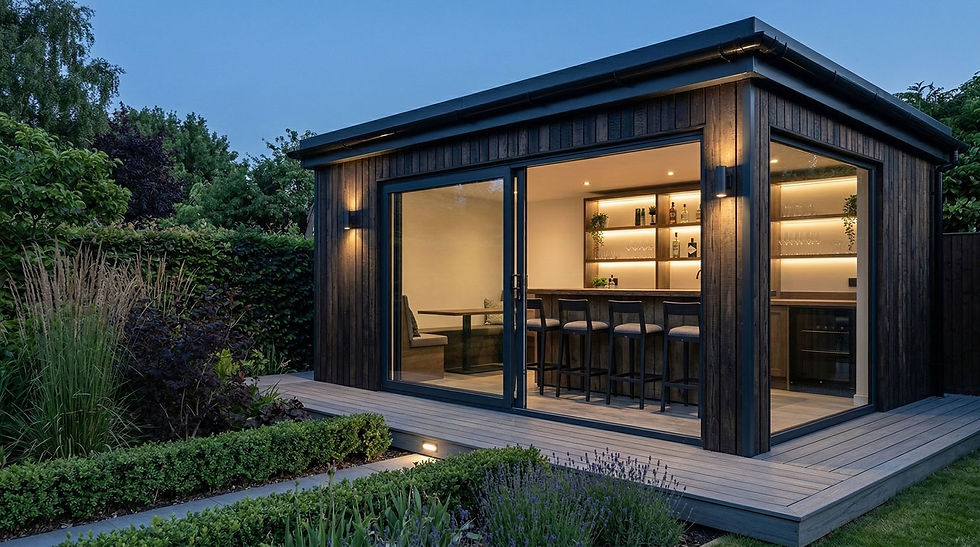
A fully clad insulated structure with a door, windows, bar counter, and seating inside. The defining advantage in Scotland is year-round usability. When the bar is properly insulated and heated, it is as comfortable in November as it is in July. Many enclosed builds also include a serving hatch to the outside, which allows the structure to function as an open outdoor bar in summer without guests needing to come inside.
One point that is frequently missed: an enclosed room in Scotland may require a building warrant if it exceeds certain dimensions. A building warrant is separate from planning permission and is handled through your local council. It is not the same process and cannot be assumed to be covered by permitted development rights. We can advise on the specific requirements for your site during a visit.
3. The Lean-To Bar Against a Fence or Wall

A bar structure attached to an existing boundary wall, fence, or the rear of the house. Using an existing structure as one wall reduces both material costs and groundworks scope, which makes this a practical format for narrower gardens where a freestanding structure would dominate the space.
The constraint worth understanding before committing to this format is load-bearing capacity. Attaching a roof to an existing fence or timber boundary works only if the boundary can carry the load, or if the bar structure is self-supporting at the rear and using the fence as a visual enclosure rather than a structural element. Not all fences can take the weight of a roof without reinforcement, and finding that out mid-build is an expensive moment.
4. The Bar with a Covered Seating Area

A bar structure on one side with a covered seating zone extending outward under a continuous or attached roof. The result is a single covered entertaining space: drinks at the bar, seats in front, and enough structure around it to sit comfortably alongside features such as water features. In Scottish gardens, covered outdoor space is worth considerably more than uncovered space, and combining the bar and seating zone under one roof makes both more usable across the shoulder months.
The junction between the bar roof and the extended seating canopy is a common point of failure on builds where the two elements were not designed together. When two separate rooflines are butted together rather than integrated from the start, water finds the join.
A bespoke pergola or canopy designed as part of the bar structure, rather than added later, avoids this entirely.
5. The Corner Garden Bar

A bar structure set into a garden corner, using two existing boundary walls as natural sides. Only the open faces need cladding and roofing, which reduces material costs and keeps the footprint compact. The rest of the garden stays clear. This format suits gardens where space is the main constraint and a freestanding structure is not realistic.
Corner sites concentrate water from both boundary walls onto the bar structure during heavy rain. That is twice the drainage load compared with a single-aspect lean-to, and the guttering and drainage design needs to account for it from the start. It is a detail that a kit bar will not address and a bespoke build will.
6. The Bar Integrated with an Outdoor Kitchen

A bar counter and outdoor kitchen as one continuous structure. One runs into the other, keeping the cook and the guests in the same space across a single entertaining run. One groundworks dig and one electrical installation covers both structures, which reduces the overall project cost compared with two separate builds.
The height transition between the two elements needs to be designed in from the start. Bar counter height is typically 1,050 to 1,100mm; kitchen worktop height sits at 900 to 910mm. When this transition is worked into the original structure alongside our outdoor kitchen build, it looks deliberate. Retrofitting a step change in worktop height into an existing structure is awkward and more expensive than getting it right at the design stage.
7. The Tiered Garden Bar

A bar structure positioned on a raised platform or deck level, accessed by steps from the main garden. The elevation creates a focal point and a clear sense of arrival: stepping up to a bar feels different from finding one at ground level around a corner. In sloped gardens where level changes are already part of the design, this format integrates naturally rather than imposing a new structure.
Raised structures need a stronger base specification than ground-level builds. The load from the bar structure passes through the platform to the ground, and that load path needs to be engineered, particularly where the platform is timber decking rather than a concrete base. This is not a detail that varies with personal preference; it is a structural requirement that affects what the platform needs to be built from.
8. The Garden Pub with Serving Hatch

An enclosed garden pub room with a hatch that opens outward onto the garden or patio. In summer, the hatch turns the enclosed room into an outdoor bar; in winter, it closes and the room stays warm. This format works well in larger gardens where the pub room is positioned apart from the main entertaining terrace, with the hatch bridging the two zones when the weather allows.
The hatch itself is a detail that is often underspecified. Inadequate sealing around a serving hatch opening is one of the most consistent sources of water ingress in enclosed bar structures. The hatch needs to be designed and fitted as a weatherproof opening from the start, not treated as a simple hole in the wall that can be sealed later.
9. The Small Garden Bar

A single-run unit, 1.5 to 2 metres wide, against a fence. A bar top, two shelves, a fridge beneath, and a power supply: that is a complete, functional bar. The build does not need to be large to be worth doing properly. A well-specified small bar in the right position changes how the garden gets used just as much as a larger structure.
In a small garden, the bar is visible from the house for most of the year. Material choice and finish quality matter more in that context, not less. Cheap cladding on a compact structure stands out because there is nowhere else to look. Quality cladding and a well-fitted bar top in a small garden reads as considered rather than improvised.
10. The Year-Round Scottish Garden Bar

A fully enclosed structure with insulation, heating, and double-glazed openings. Designed for use from January to December in a Central Scotland climate. The test is simple: if the bar is not comfortable on a Friday evening in February, it will not be used for five months of the year. Most enclosed bar builds that fail this test do so because heating was treated as an afterthought.
Year-round use in Scotland requires a permanent heat source. A portable electric heater is not a heating strategy. A wall-mounted electric panel heater on a thermostat is the minimum; infrared overhead heating is better for semi-open structures where warm air disperses. Either way, the power supply needs to be factored into the groundworks at the start of the project, not run as an extension lead through the door once the structure is finished.
What to Include in Your Garden Bar
The right specification depends on how the bar will be used, but these are the components worth thinking through before you commit to a design.
The bar top is the most visible surface and takes the most punishment. Hardwood options like iroko or oak are premium finishes, but both require annual oiling in a wet climate. Porcelain is non-porous and frost-resistant with no maintenance requirement. Composite decking board is a mid-range option that performs well in persistent damp.
Under-bar refrigeration is either a standard undercounter fridge or a keg tap system. A keg system needs a gas line and a regular cleaning regime. Factor both into the brief before specifying it, not after.
A sink makes the bar genuinely functional. Cold water only is straightforward to plumb. Hot water requires either a small water heater under the bar or a supply run from the house; both add cost and are worth confirming at design stage.
Open shelving behind the bar handles bottles and glasses. Lockable storage below protects stock. Lighting should include LED strip under the bar top, overhead festoon or string lights, and spotlights inside any enclosed structure. Minimum power provision is two double sockets behind the bar and one below for the fridge. Add a USB socket if the bar will be used for phones or a Bluetooth speaker.
Materials for a Garden Bar in Scotland
The top 10 for this search is written entirely by kit sellers and furniture retailers. Material choices that appear in those articles were not made with Scottish conditions in mind.
Composite cladding on the exterior requires no painting, no treating, and holds its finish through wet winters. It is the low-maintenance choice for a structure that will be exposed to persistent Scottish damp year-round.
Hardwood bar tops in iroko or oak are the premium option, but they require proper sealing before installation and annual oiling thereafter. In sustained damp, skipping a year shows. If you want the look without the maintenance, porcelain achieves a similar result with none of the upkeep.
An EPDM rubber roof, either flat or low-pitch, is fully waterproof and handles freeze-thaw cycles without cracking. It carries a 20-year lifespan. This is the standard on all our garden bar builds because it is the roofing material that works in this climate.
The structural frame should be pressure-treated timber, specified at treatment class H3 or H4 for ground contact and persistent damp. And avoid untreated softwood cladding: it is common on budget kit bars and fails in three to five years in Scottish conditions. The same applies to thin-gauge steel fixings, which rust, and any flat roof membrane not rated for freeze-thaw cycling.
Planning Permission and Building Warrants
Most garden bars fall under permitted development and do not require planning permission, provided the structure is single-storey, has eaves no higher than 2.5 metres, sits under 4 metres overall height with a dual-pitch roof (or 3 metres with any other roof type), and covers less than 50% of the total garden area.
Different rules apply if your property is listed, sits within a conservation area, or falls within a National Park boundary. Always check with your local authority if any of those apply.
In Scotland, there is an additional consideration that applies to enclosed structures: the building warrant. A building warrant is a separate approval to planning permission and is handled through your local council. It may be required for enclosed bar buildings over certain dimensions, and it is not covered by permitted development rights.
Ready to Plan Your Garden Bar?
If you have a garden and a rough idea of what you want from a bar structure, the next step is a site visit. We look at the space, talk through open versus enclosed, materials, and position, and give you a clear picture of cost and scope before any decisions are made.
Get in touch to arrange a free site visit, or take a look at our garden bars service to see what we build.


