Pergola design ideas, from a landscaper's perspective
A pergola does several things at once. It defines a zone in a garden that might otherwise be undefined, supports climbing plants that bring vertical interest and seasonal change, and frames an outdoor room that connects the house to the rest of the space. For a relatively simple structure, that is a considerable amount of work.
Most of what you find online when you search for pergola ideas is a gallery. Forty images, a numbered list, no real advice on how any of it works in a UK garden. This guide takes a different approach. It covers configurations, materials, climbing plant choices, integration with the wider garden, and what to think about before you commit to anything. We design and build bespoke timber pergolas across Glasgow and Central Scotland, and what follows is drawn from that work.
Freestanding pergolas as garden anchors
A freestanding pergola has no structural connection to the house. It stands in the garden on a prepared base, and its job is to anchor a space: a dining area, a seating zone, or the end of a sightline from the house.
Sizing matters more than most people expect. A dining pergola for six people needs roughly 3.6m x 3m inside the posts to work comfortably. Add chairs around a table and you quickly discover that 3m x 2.4m is too tight to pull back a chair without scraping the uprights. A seating area, where people are not getting up and down constantly, can work at 3m x 3m or smaller.
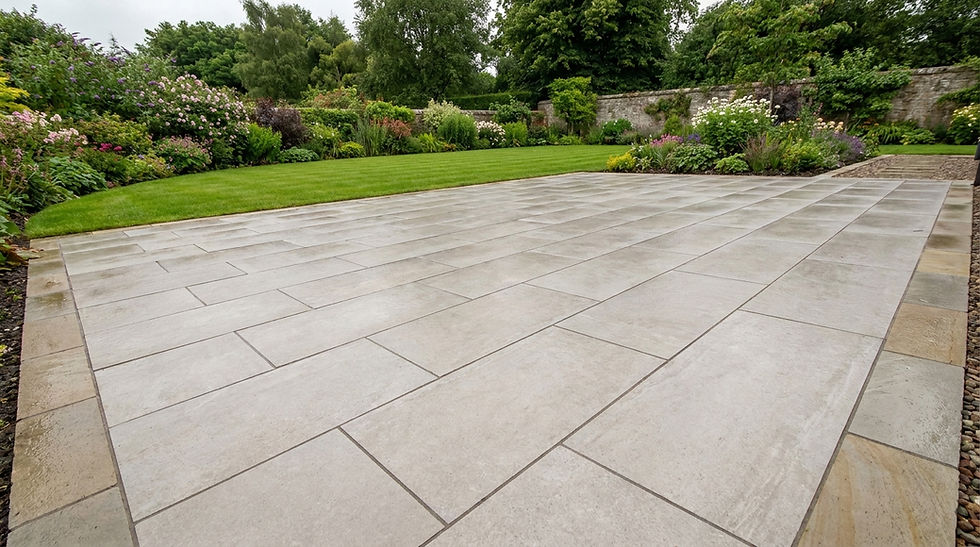
The base matters as much as the structure. A timber pergola sitting on loose shingle or membrane-over-soil will move over time, and that movement works against the joints. Built over a properly designed and levelled patio design and build, the structure stays level and square for decades.
Freestanding designs suit gardens where the pergola is a destination: somewhere you walk to through the garden rather than step straight out to from the house.
Attached pergolas as house extensions
An attached pergola fixes to the house wall with a wall plate, typically at 2.4m or above. Everything below that height becomes sheltered outdoor space. Much below 2.1m and the structure starts to feel like a low tunnel rather than an outdoor room.
These designs suit back terraces and patio doors where you want immediate shelter off the house without building a full extension. They are common over outdoor dining areas where the kitchen is visible through the glazing, and the cooking-to-eating journey is a few steps across a covered terrace.
Weather sealing matters at the wall plate. Untreated softwood fixed against masonry traps moisture at the joint. Properly treated or naturally durable timbers, with lead flashing or a drip cap fitted correctly, keep the junction watertight. Miss this detail and the wall stains and the timber rots from the contact point outwards.
An attached pergola works particularly well as the overhead structure for an outdoor kitchen, where shade, partial shelter, and a defined zone for cooking and dining are all useful. The roof frame also takes integrated lighting without the need for separate pole-mounted fittings.
Pergolas over outdoor kitchens, fire pits, and garden bars

The strongest design opportunity in most larger gardens is using a pergola as the defining structure for a cooking or entertaining zone. The practical requirements change depending on what sits beneath.
Over an outdoor kitchen, the pergola roof must sit at minimum 2.4m above cooking surfaces, and ideally 2.7m or higher if a charcoal grill or serious gas burner is part of the brief. Outdoor kitchen design and build should be discussed alongside the pergola from the start, because gas line routing, ventilation, and electrical supply all need to be planned together. Adding those elements after the structure is up creates problems.
Over a fire pit, clearance requirements are higher still: a minimum of 2.5m above the fire bowl for open-burning setups. Fire pit installation within a covered structure almost always means an open-sided frame rather than a closed roof, so that heat and smoke can disperse freely rather than collecting at head height.
Garden bar installation under a pergola roof is one of the most popular configurations in larger garden projects. The pergola defines the bar zone, carries the lighting rig, and keeps the space dry enough to use on a wet evening.
Walkway and multi-bay pergolas for larger gardens
A single pergola is a destination. A walkway pergola is a journey.
Linear structures linking different parts of the garden, usually three or four bays long, support climbing plants along the entire length and create a transition between zones rather than a fixed point. The garden has somewhere to go rather than somewhere to sit.
Wisteria over a walkway pergola is one of the most striking things a mature garden can produce in May. It is also one of the heavier plants you can put on a structure: size the timbers for what the pergola will weigh in fifteen years, not what it weighs at installation.
Multi-bay configurations work well for larger entertaining spaces where one area needs to contain a dining zone, a lounge area, and a bar within a coherent overhead structure. Open timberwork between the bays gives definition without solid walls, keeping the space connected while making each zone feel distinct.
Materials
The SERP covers materials extensively. Here is what matters in practice.
Oak is the premium choice. It weathers to silver-grey without treatment, stays dimensionally stable, and a properly jointed oak pergola lasts thirty years or more. It is also the most expensive option.
Larch is a durable softwood that performs well outdoors without treatment. It tends to shrink slightly as it dries, which is why joinery should be cut with a little tolerance. A good timber merchant will state moisture content at point of sale.
Pressure-treated redwood is the most affordable option and, with good maintenance, can last fifteen to twenty years. The maintenance part matters in a Scottish climate: oil or stain every two to three years, not occasionally. Skip it and the end grain opens up, which is where rot starts.
Cedar is lighter than oak or larch, naturally rot-resistant, and holds paint and stain well. It is a common choice where a lighter visual weight suits the surrounding garden.
Aluminium pergolas are widely available online, and some have louvred roofs with integrated LED systems. For a design-led garden build where timber runs throughout the hard landscaping, they rarely integrate convincingly. The material weight and profile are different enough that the pergola reads as a separate purchase rather than part of the garden.
Designing for climbing plants
Most people think about the pergola first and the plants second. The plants should be part of the design from the beginning.
Within two or three growing seasons, a healthy wisteria, climbing rose, or grape vine will cover the pergola roof almost completely. At that point the timber is carrying a load it was not carrying at installation: not just the structure's own weight, but a significant mass of mature plant and wet foliage after heavy rain.
Wisteria is the most dramatic choice and the most demanding structurally. It grows heavy, slow to establish, and lives for decades. Size the timbers and fixings for the long game.
Climbing roses are manageable and bring fragrance and colour without the structural demands of wisteria. Clematis mixes well with roses, extends the flowering season, and fills gaps in the canopy effectively. Grape vines are decorative and productive. Jasmine is fragrant and grows at a lighter structural weight than most of the alternatives.
A well-planned planting service will specify varieties suited to the structure's timber sizing, the soil conditions, and the light levels at the pergola's position, and plan for how the plants will distribute themselves across the frame over ten years.
Lighting and electrical integration

Pergola lighting transforms the space after dark. Warm-white festoon lights strung between the roof beams are the most common option and the most forgiving: easy to replace, adjustable, and reliably effective for the ambience most homeowners want.
For something more permanent, integrated LED downlighters set into the roof frame work well over dining tables where direct light on the table surface is useful. Post-base uplighters add drama to the structural posts without cluttering the canopy with fittings. A single pendant hung from the ridge beam works particularly well on attached pergolas where the roof height is fixed and the dining table position is known.
The electrical planning is straightforward: armoured cable buried in the foundations or routed up a post, weather-sealed fittings throughout, and a switched circuit back to the house. Plan this at the design stage. Running cable through completed timberwork is possible but fiddly, and often results in surface-mounted conduit that looks exactly like the afterthought it is.
Working with the garden, not against it
The most common pergola problem has nothing to do with the structure itself.
A catalogue pergola at a standard size, placed on a patio that was never designed to take it, looks like what it is: something added later. Post positions do not align with paving joints. Roof height conflicts with the kitchen soffit or an upstairs window. The planting behind does not relate to the structure. The overall effect is a garden that happens to have a pergola in it, rather than a garden designed around one.
Working with a bespoke garden design service from the start produces a different result. The paving module is set out to land posts on joints. The roof height is decided in relation to the eaves line and the sightline from the sitting room. The planting scheme is briefed knowing the structure will eventually be covered by it.
Scott has seen this mistake often enough that the design conversation at M&S almost always starts with the whole garden before it reaches the pergola specifically.
Designing for Scottish weather
Pergolas in West Central Scotland face more wind exposure, more rainfall, and more frost cycles than equivalent structures further south. The design response is not a radical departure, but it is specific.
Timber sizing should be conservative. What is structurally adequate in still conditions may be undersized on the exposed side of a Bearsden or Newton Mearns garden in January. The difference is typically one size up on the rafters and bracings, which adds little to cost and a great deal to longevity.
Fixings should be stainless steel throughout. Galvanised fixings streak and stain timber within a few Scottish winters. The staining is largely irreversible on oak and larch, and once visible it ages the structure quickly.
Joints should be cut to shed water rather than trap it. Bird's mouth cuts on rafters, angled post caps, and open rather than fully concealed connections all move water away from the structural points, where rot takes hold if moisture is allowed to sit.
Our pergola design and build service is built around these details. They are not visible in the finished structure, but they are what determines whether the pergola holds its shape and finish for ten years or for thirty.
Planning permission, briefly
Most garden pergolas fall under permitted development. The limits that matter are height above 2.5m and position within 2m of a boundary. Both trigger the need for a planning application.
For attached pergolas, the cumulative footprint rule applies. If your property already has a rear extension or a large outbuilding, the pergola's footprint may push the total over the permitted development allowance for your plot size. Check that figure before designing to a footprint that will not be approvable.
Listed buildings and conservation areas are a different situation. The standard permitted development limits do not apply in the same way, and the rules vary by designation. Check with your local planning authority before ordering materials.
For most straightforward residential projects, a freestanding pergola in the middle of the garden or an attached lean-to at a sensible height qualifies as permitted development. The Planning Portal provides the full criteria and a useful flowchart. Where there is any doubt, a pre-application enquiry with your local council takes a few weeks and removes the risk of building something that has to come down.
Start with the garden, not the pergola
A pergola works best when it is designed alongside the garden: the right size for the paving module, the right height for the house and the sightline, the right structure for the climbing plants you want in ten years. Ordered separately and added later, it rarely sits as well as it should.
If you are planning a pergola as part of a wider garden project across Glasgow and Central Scotland, a free site visit is the best starting point. You can also find out more about our pergola design and build service and the timber options we work with.