What the best driveway ideas have in common
You want to replace a failing driveway, or install one for the first time, and you want to get the decision right. There are five main surface materials used on residential driveways in the UK, and each one performs differently depending on ground conditions, drainage, and what the surrounding property needs.
This guide covers what each surface actually offers, what good installation involves, and what separates a driveway that performs for twenty years from one that starts lifting and rocking within three.
The main driveway surface materials
Material choice is where every driveway project starts. The surface you choose shapes drainage requirements, maintenance commitments, planning permission implications, and how the approach reads alongside gates, walling, and planting. Each option has real trade-offs, and the right answer depends on your site, your priorities, and your budget.
Block paving
Block paving covers a wide range of products. At the lower end, pressed concrete blocks. At the premium end, clay pavers and natural stone setts. They look similar when newly laid. After five or six winters, the difference becomes obvious.
Concrete blocks absorb water into their surface. Water freezes, expands, and the face spalls. On a poorly drained base, the blocks also rock and lift as the sub-base shifts through freeze-thaw cycles. Clay blocks and natural stone setts are considerably denser and far more resistant to this. The higher initial cost is usually recovered in longevity and avoided repair bills.
Design options include herringbone, basket weave, and stretcher bond. Herringbone is the strongest pattern for a traffic-bearing surface because it locks blocks laterally against each other. What separates a good block-paved driveway from a poor one is not usually the pattern. It is joint width, the consistency of the colour selection across the batch, and the quality of the edge restraint.
Block paving without solid edge containment spreads outward over time. The blocks at the perimeter lose their lateral support and the whole surface loosens from the edges inward. Permeable block paving is available from several manufacturers, with wider joints filled with gravel rather than kiln-dried sand, allowing rainfall to pass through rather than run off the surface.
Resin bound
Resin bound surfacing is a mix of natural aggregate and clear UV-stable polyurethane resin, trowelled onto a prepared base as a single continuous surface. There are no loose stones and no joints to maintain.
The finish is clean and contemporary. Aggregate colour options range from buff and silver grey through warm amber and red blends to darker basalt tones. In Scottish light, which leans cooler and greyer than much of southern England, neutral aggregates tend to look more consistent across the seasons than warm-toned choices. Getting physical samples outdoors at different times of day before committing to a colour is worth the effort.
Resin bound surfaces are fully permeable, which simplifies planning permission in most cases. Maintenance is minimal: a jet wash once or twice a year keeps the surface clean. There is no re-sanding, no weeding between joints, and no loose material tracking into the house.
The material is explored in more detail in our resin bound driveway ideas guide, including aggregate colour options and how the surface performs across different property styles.
Gravel and loose stone
Gravel has the lowest material cost of any professional driveway surface and can look considered and appropriate when installed well. The critical variable is edge containment. Without a firm border, gravel migrates onto adjacent paths, lawns, and the road within a season.
High-rainfall sites need careful attention to drainage planning and stone grade. Fine decorative gravel on a site with poor natural drainage compacts into mud. An angular, well-graded stone drains better, stays firmer underfoot, and resists migration more effectively than round, decorative alternatives. In areas with significant rainfall, positive drainage away from the surface matters as much as the stone selection itself.
The security benefit is worth noting for homeowners who park on the drive overnight. Gravel is one of the most effective passive deterrents against vehicle theft and nocturnal intrusions; the sound of someone walking on it carries significantly further than footsteps on a hard surface.
Porcelain and natural stone flags
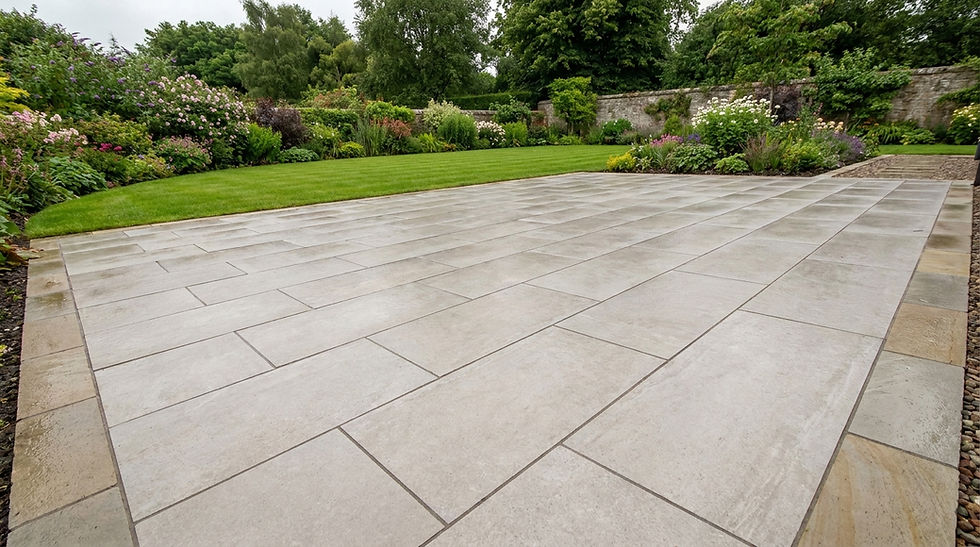
Large-format porcelain and natural stone flags are the premium choice for level or near-level driveways with a generous approach. They suit period properties and new builds equally well, and the material choices available reflect that range.
Frost-resistant porcelain has a water absorption rate close to zero, which means UK winters present no structural problem for the surface itself. Natural sandstone and limestone are more variable. Porosity in natural stone matters; not all imported flagstone suits exposed conditions in higher-rainfall areas, and it is worth confirming the provenance and frost-resistance specification before committing to a stone.
Porcelain requires a full rigid mortar bed. Get the base preparation wrong and you will see cracking and rocking flags within a year or two. The installation takes longer than block paving or gravel, and the cost reflects that. The same material extends naturally from the driveway into the patio, which is why the paving and patios service covers the full range of porcelain and natural stone options for both.
Tarmac
Tarmac is practical, fast, and cost-effective per square metre. It is the default surface on high-volume commercial approaches and on residential driveways where function takes clear priority over appearance. It also works well as a sub-base layer beneath resin bound surfacing, providing the rigid, stable foundation that resin requires.
Honest assessment: if you are investing in stone gates, dressed walling, and planted margins, a black tarmac surface works against all of that visually. If you are primarily concerned with function and cost on a large area, it does that job reliably.
What good installation actually involves
The element that determines whether a driveway lasts two decades or three years has nothing to do with the surface material. It is what goes underneath.
Sub-base depth depends on traffic load, material choice, and ground conditions. A standard residential driveway carrying cars needs a minimum of 150mm of compacted MOT Type 3 stone. Sites with softer subsoil, or where heavier vehicles access the property, need 200 to 250mm. Skimping on sub-base depth is the single most common reason driveways fail prematurely. A surface that looks perfect on day one and begins rocking or cracking within three years was almost always built on a base that was too shallow, incompletely compacted, or both.
Edge restraints provide the lateral resistance that stops surface materials migrating outward. Without solid edge containment, the perimeter of the drive slowly loses definition and the surface material loosens from the edges inward.
Falls for surface drainage are the third element contractors most often underspecify. Water on a flat driveway has nowhere to go. It pools, freezes in winter, and accelerates deterioration of whatever surface is above it. The standard approach is a minimum fall of 1 in 60 towards a drain, channel, or planted border. Where the drive falls towards a building, a linear drainage channel intercepts run-off before it reaches the wall or threshold.
Three questions worth putting to any contractor before agreeing a quote: what sub-base depth are you specifying, what edge restraint system are you using, and how are you managing the surface water fall. Vague answers to any of those three usually indicate the job they have priced.
Planning permission and drainage
Replacing an existing driveway with a non-permeable surface typically requires planning permission. Replacing it with a permeable surface generally does not, because permeable surfaces allow rainfall to soak into the ground and satisfy Sustainable Drainage System (SuDS) requirements.
Permeable options include resin bound surfacing, permeable block paving, and gravel. Standard closely jointed block paving, tarmac, and solid concrete are non-permeable. Porcelain flags with open joints on a permeable sub-base can be installed permeably, but this requires deliberate specification rather than default practice.
Scottish permitted development rules apply, and interpretation varies between councils. Confirm the specific requirements for your project with your local planning authority before committing to a non-permeable surface. General guidance on residential driveway planning is available from Planning Portal.
Where surface water from a new driveway is directed into an existing drainage system, you may need to show the system can handle additional flow. On a standard residential site this is rarely an obstacle, but it is worth confirming early rather than late in the project.
The driveway as part of the front garden
The driveways that look best are rarely treated as a standalone project. They are designed as part of a complete front-of-house scheme, where the surface material, the gate piers, the boundary walling, any level changes, and the planting are chosen together from the outset.
This matters in practical terms, not just visual ones. Choose a buff porcelain surface then add gate piers in an unrelated brick and the two materials argue with each other. Leave a margin of topsoil between the drive edge and the boundary and that margin becomes a persistent weed strip unless it is properly planted and edged. If there is a level change between the pavement and the entrance threshold, steps need to be built into the scheme from the start, not retrofitted after the drive is laid.
Typical decisions in a coordinated front-of-house project: driveway surface material and drainage fall direction, gate style and pier material chosen to complement the drive, boundary walling in natural stone or dressed concrete block, lighting integrated into the piers, and planted margins with low-maintenance species that hold the edges without spreading onto the hard surface.
These elements work naturally alongside the walling and steps service and the garden design service for homeowners who want to treat the whole front of house as one project rather than three separate jobs.
What does a new driveway cost?
Installed cost ranges per square metre by material:
Gravel with professional installation: £25 to £50/m²
Block paving: £80 to £130/m²
Resin bound: £80 to £130/m²
Porcelain or natural stone flags: £100 to £160/m²
What moves the price within these ranges: total area, site access, the condition and depth of any existing sub-base, gradient, and edge complexity. A straightforward rectangular drive on level ground with good vehicle access costs considerably less than an irregular shape with a level change, tight access, and existing hard surfacing to break out.
Sub-base preparation typically accounts for 40 to 60 percent of total installed cost regardless of surface material. That proportion is not a variable to negotiate away. Quotes that come in significantly below these ranges are usually achieving that by reducing foundation depth, skipping compaction stages, or both.
Getting the right result
Any driveway project done properly starts with a site visit to assess sub-base condition, understand drainage requirements, and work out how the drive connects to gates, walling, and any level changes. That assessment shapes the specification, the specification shapes the cost, and the cost is what you are actually comparing when two quotes arrive at very different numbers.
The driveways service covers how M&S approaches every project from first site visit through to completion, including the sub-base specification and drainage planning that most quotations leave underspecified.
Frequently asked questions
What is the most durable driveway surface?
Natural stone setts and resin bound surfacing are the most durable options long-term when installed correctly. Block paving using quality clay or natural stone units is also durable. Concrete blocks perform less well in freeze-thaw conditions because they absorb water at the surface, which causes spalling as it cycles. In every case, sub-base preparation is the dominant factor: a premium surface on a poorly compacted base will show movement within a few years regardless of what material sits on top.
Do I need planning permission for a new driveway in Scotland?
Permeable surfaces, including resin bound, permeable block paving, and gravel, generally do not require planning permission because they meet SuDS requirements. Non-permeable surfaces replacing an existing driveway typically do require permission. Scottish permitted development rules apply, and interpretation varies between councils, so confirm the specific requirements with your local planning authority before starting.
What is the best low-maintenance driveway option?
Resin bound surfacing has the lowest ongoing maintenance requirements of any professional driveway surface. There is no re-sanding, no weeding between joints, and no loose material. A jet wash once or twice a year is sufficient to keep it clean. Porcelain flags also require minimal maintenance once correctly bedded on a full mortar bed. Gravel needs occasional topping up and redistribution; block paving requires re-sanding every few years as the joint material depletes.
How long should a new driveway last?
A properly installed resin bound or natural stone driveway should last 20 to 25 years with minimal maintenance. Block paving on a sound sub-base can last 20 to 30 years. Tarmac typically needs attention at 15 to 20 years. In all cases, the sub-base is the determining factor. A premium surface on a poorly prepared base will show movement within five years; the same surface on a correctly specified and compacted foundation will still be performing two decades later.